Cashmere Wrap Supplier Playbook: Pashmina, Ponchos and FW26 Travel Layers
Cashmere Wrap Supplier Playbook: Pashmina, Ponchos and FW26 Travel Layers
Share
Issue Time
Sep 29,2026
Summary
A cashmere wrap supplier's guide to the 2026 travel-layer programme: the four formats buyers confuse, the specification sheet a factory should hand you, seamless versus cut-and-sew poncho construction, what a pashmina claim actually means, and the buy calendar behind the season.
A wrap is the easiest thing in a cashmere catalogue to sell and the hardest thing to buy. It has no armhole to fit, no size grading to argue over and no returns pattern tied to body shape — so it clears the buying meeting quickly. Then the reorder arrives eight weeks later and it does not feel like the first one: the fringe is thinner, the hand is stiffer, the colour has drifted a shade warmer. Nothing on the paperwork catches it, because the paperwork said "100% cashmere" and stopped there.
That gap is the whole reason a wrap programme deserves the same specification discipline you would apply to a sweater. This guide walks through the four formats the market is currently asking for, the fibre claims behind the word pashmina, the construction choices that decide how a poncho sits on a shoulder, and the calendar that decides whether your stock lands before the travel season or after it.
1. Why the Wrap Became the Category Buyers Plan Around First
The travel layer has moved from accessory to programme. Two forces are behind it. The first is styling: through Fall/Winter 2026, cashmere appeared on the international runways as an everyday layering material rather than an occasion fabric — enveloping double-faced maxi silhouettes, ribbed knits layered over shirting, poncho-style volumes cut wide and unstructured. Apparel Resources' FW26 trend review catalogues the shift directly, noting that houses worked the fibre into pieces intended for transitional wear rather than festive dressing.
The second force is practical. A wrap crosses seasons in a way a sweater cannot: the same piece works as a shoulder layer in a cool office, a blanket on a long-haul flight, a shawl over evening wear, and a scarf when folded. Market research on pashmina and wrap assortments keeps arriving at the same conclusion — the "multifunctional fashion" angle is what pulls these pieces into the traveller's bag, and the buyers stocking them are increasingly positioning them as year-round staples rather than December-only inventory. Accio's wrap and pashmina category research frames the segment this way, with fringed, oversized, dual-purpose pieces leading demand.
What that means for a buying plan is straightforward. Wraps carry low size risk, wide positioning latitude and strong gifting crossover, which makes them the natural entry point for a retailer testing a new cashmere supplier — and the natural place to start a reorder relationship once the fibre and colour hold.
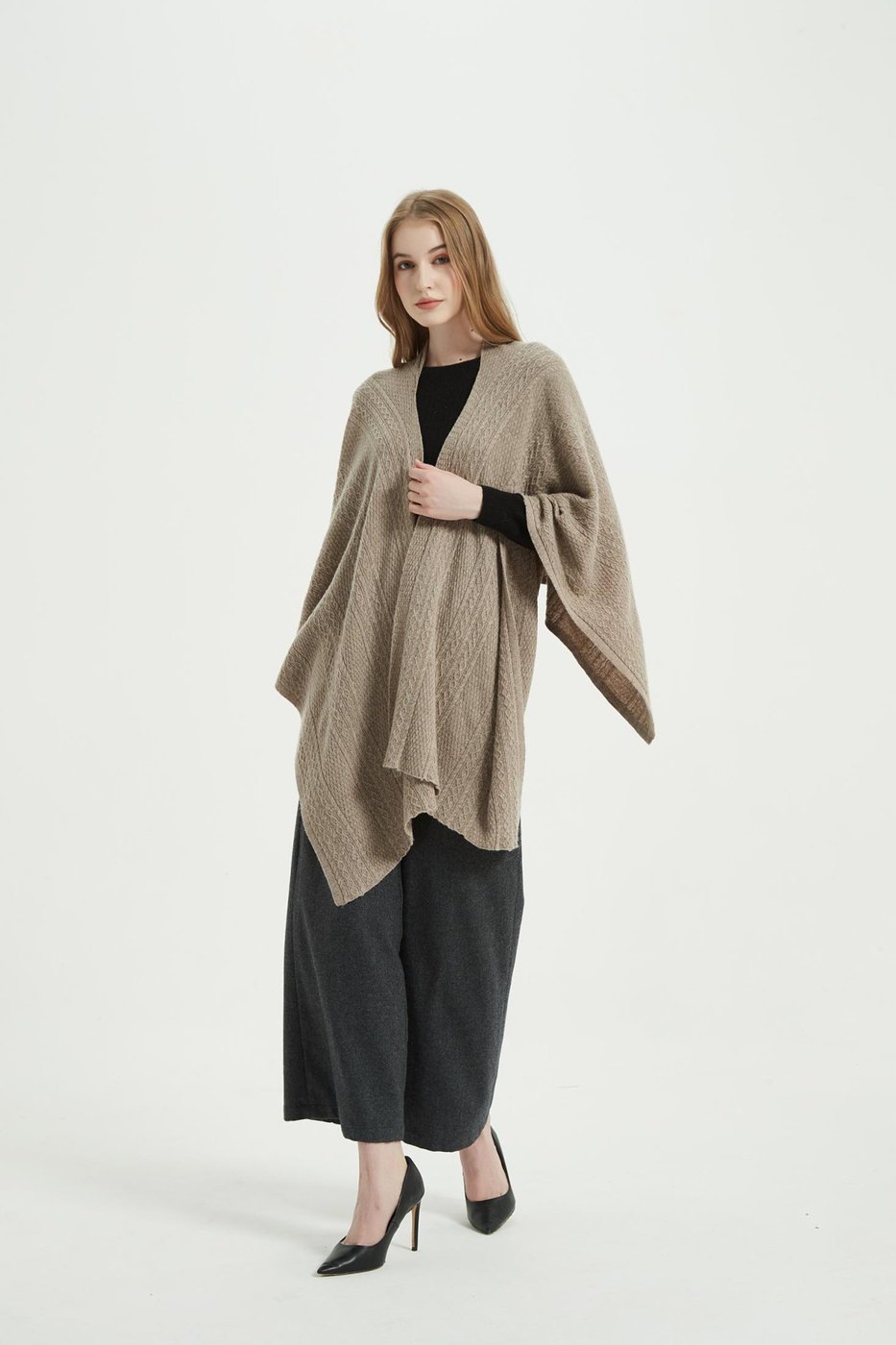
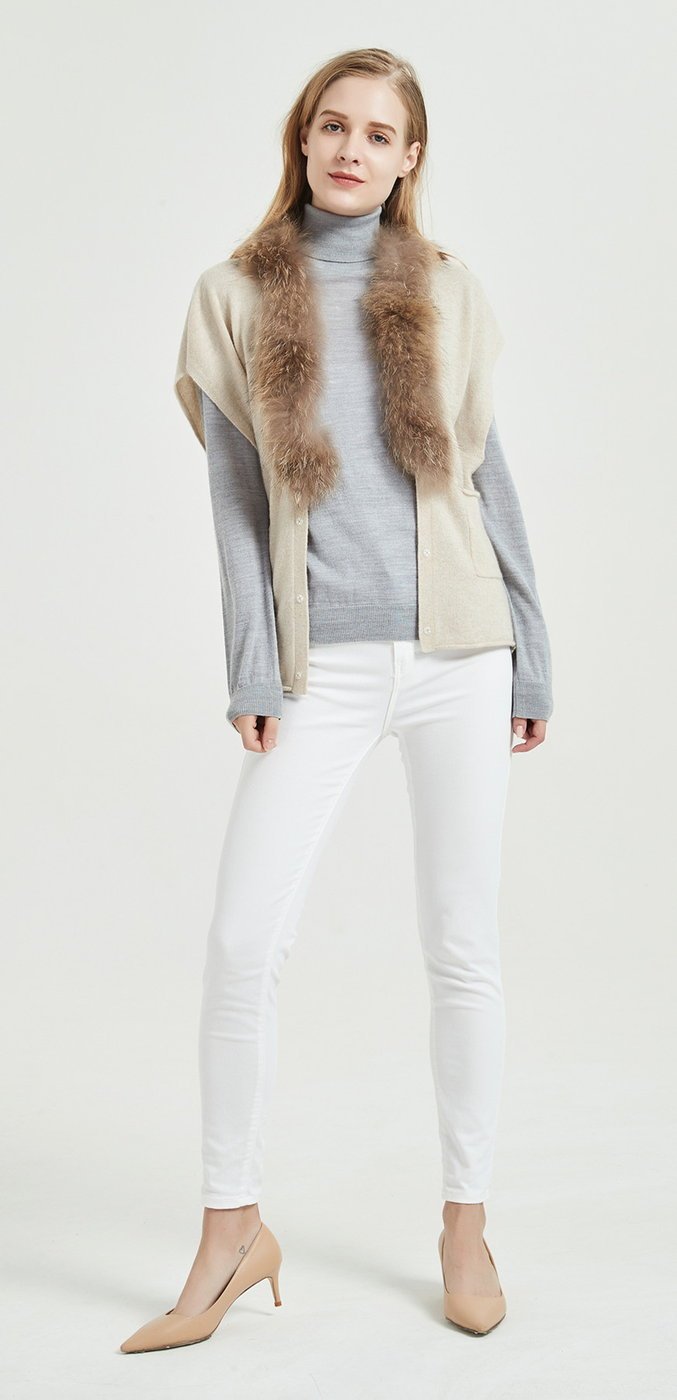
Layered styling is where the wrap programme lives: an unstructured cashmere layer worn over a fine-gauge knit, wide enough to read as outerwear indoors and light enough to travel.
2. Wrap, Poncho, Stole, Pashmina: Naming the Four Formats Correctly
Most sourcing friction in this category is a naming problem. Four words get used interchangeably in enquiries, and they describe four different products with four different production routes. Getting the vocabulary right before the first sample request saves a full development cycle.
Format
What it actually is
Typical build
Buyer fit
Stole
A flat, rectangular woven piece, usually narrower and dressier than a scarf
Woven worsted, 70 × 180 cm to 70 × 200 cm, light hand, often self-fringed
Department-store and boutique core; easy size-free SKU
Wrap / shawl
An oversized stole wide enough to cover the shoulders
Woven or knitted, 80 × 200 cm and up, 300–600 g, fringe or bound edge
The travel and gifting hero; strongest multi-season sell-through
Poncho
A garment with a neck opening and no sleeves — it is worn, not draped
Knitted and often seamless, 4-ply to 6-ply, 400–900 g
Fashion-forward accounts; silhouette-led ranges
Ruana
An open-front poncho with a front split; two panels meeting at the back of the neck
Knitted, wide draped front points, no closure
Premium boutique; photographs as a statement layer
Pashmina is not a fifth format — it is a fibre claim. It describes the down fibre from high-altitude Himalayan goats, traditionally hand-spun and hand-woven, and it can be made into any of the four shapes above. The distinction that matters in a technical conversation is diameter: pashmina fibre typically measures roughly 12–16 microns, while standard machine-spun cashmere generally runs 15–19 microns. Premium Inner Mongolia cashmere selected below about 15.5 microns sits in a comparable hand-feel band while remaining machine-spinnable at volume — the range we cut into our pashmina-style wraps, worsted stoles and shawls.
Ask this before anything else: "Is the pashmina claim about the fibre or about the look?" If the answer is about the look, you are buying a cashmere or cashmere-blend wrap and should specify — and label — it that way. The US Wool Products Labeling Rules put the fibre-content and origin disclosure obligation on the label, and the same discipline protects you in every other market.
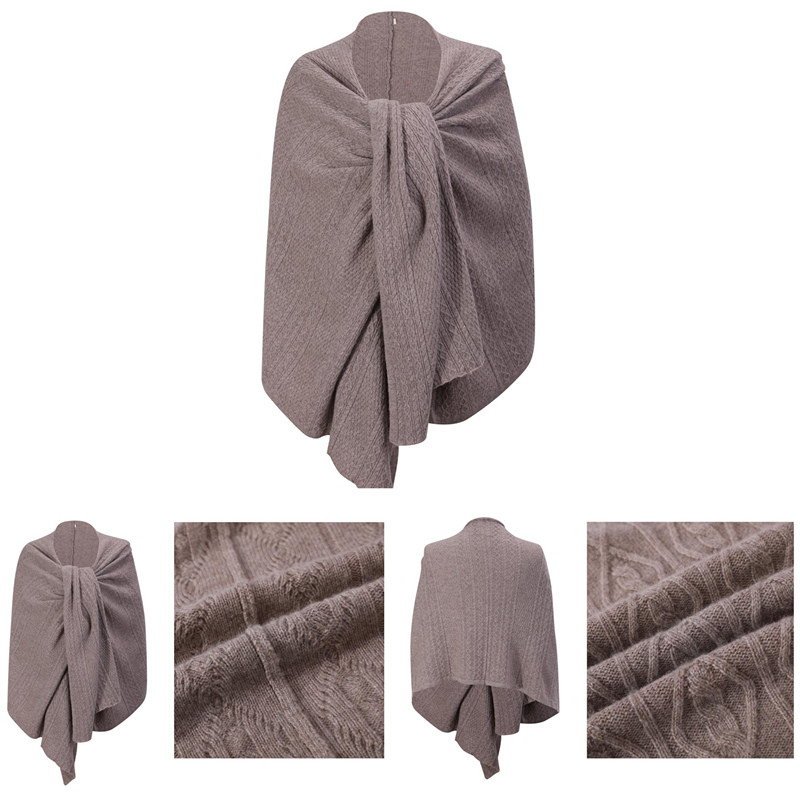
Cable-knit shawl shown flat with construction and stitch detail — the format's dimensions, edge treatment and gauge can all be read off a single reference image like this one.
3. The Specification Sheet a Supplier Should Hand You First
A credible wrap supplier will send a specification sheet without being asked twice. If the sheet lists only "100% cashmere" and a size, you are being sold a photo rather than a product. Here is what a workable sheet contains, and what each line protects you from.
Line item
What to require
Why it matters on reorder
Fibre composition
Percentage by fibre, plus origin of the raw material
Origin drives hand feel; a blend substituted later reads instantly
Fibre diameter
Mean micron measured by an instrumented method, not an adjective
Micron creep is the most common silent quality drift
Yarn count and ply
Nm count plus ply, for example 2/26 Nm or 2/28 Nm, and a stated ply number
Determines weight, drape and how fast the piece pills
Gauge
Machine gauge for knitted formats (7gg, 12gg and 14gg are the common bands)
Gauge changes shift the loop size and the whole surface feel
Piece weight
Grams per piece with a tolerance band, for example ±5%
The single fastest way to detect yarn being economised
Dimensions
Finished measurements after washing, not greige
Prevents the shrinkage surprise that ruins a reorder
Edge and fringe
Fringe length, twist, and whether it is knotted, twisted or self-finished
Fringe density is where yarn economies usually appear first
Colour reference
A yarn-card or Pantone reference plus a batch-match tolerance
Makes "same colour" a measurable instruction
Performance testing
Pilling and colour-fastness results on the finished piece
Turns a subjective complaint into a documented fact
Certification
Traceability or organic certification scope, and which facility holds it
Becomes label copy and marketing assets, not just paperwork
Two certifications carry most of the weight in this category. The Good Cashmere Standard is the fibre-sourcing scheme most often requested by European accounts, covering animal welfare and farm-level traceability. OEKO-TEX Standard 100 addresses the finished textile's chemical safety and is the one your customer's compliance team will ask for on the garment itself. Both are worth confirming at quotation stage rather than at shipping, because certification scope is held facility by facility — not by the trading company that answers your email.
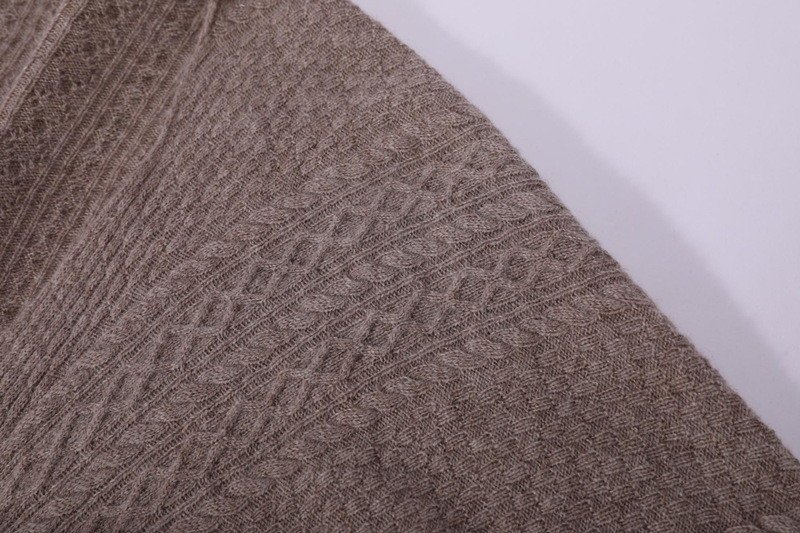
A close macro of the knitted surface. At this magnification, stitch regularity, yarn evenness and the first sign of surface fuzz are all visible — which is why a texture reference belongs in the tech pack.
4. Poncho Construction: Seamless, Cut-and-Sew, and the Trim Question
For knitted ponchos there are three construction routes, and they behave differently on the body.
Fully-fashioned, seam-assembled. Panels are knitted to shape and linked together. The advantage is that the knitter can shape the neck and shoulder line precisely, which gives the poncho a more tailored fall. The disadvantage is that every seam is a potential point of distortion if the panels are not relaxed identically before linking.
Seamless. The piece comes off the machine in one tube with the neck opening knitted in. There is no shoulder seam to pull, the drape is continuous around the body, and it travels without creasing along a seam line. Seamless also removes a full making stage, which is why it is the construction behind the cleanest-looking high-volume ponchos. Its limitation is design range: complex colour-blocking and sharp geometric panels are harder to achieve.
Cut-and-sew from a knitted panel. A flat knitted fabric is cut to a pattern and sewn. This gives the widest design freedom and the fewest tooling constraints, but the cut edges must be finished properly or the piece will roll and shed fibre. If a quotation for a knitted poncho looks unusually lean, this is usually why.
The trim question
Fur and faux-fur trims lift a poncho into a higher specification band and a different compliance conversation. Three points are worth settling in writing before sampling. First, what the trim is — natural fur, faux fur or a shearling-effect knit — because the labelling regime differs, and misdescription is a legal exposure rather than a design choice. Second, whether it is detachable, which gives your customer the option to sell the piece as two looks and simplifies cleaning instructions. Third, whether the trim is dyed to match the body or intentionally contrasting, because a dyed trim will shift shade differently from the knit over time.
For buyers specifically building a travel assortment, the practical call is often to run both: a clean untrimmed poncho as the volume SKU and a trimmed version as the statement piece, sharing one yarn lot so the colour is consistent across the range.
5. Fringe, Edge and Finish: The Details Buyers Inspect
The edge is where the hand meets the product, and it is the first place a supplier under pressure economises on yarn. Four edge treatments cover nearly everything on the market.
Twisted fringe. Yarn groups twisted before finishing. Denser, more premium, and holds its shape through washing — the standard for worsted stoles and shawls.
Knotted fringe. Hand-knotted ends. The most labour-intensive and the most obviously artisanal; expect it on hand-finished pieces.
Self-finished hem. The knit itself is finished so no added fringe is needed. Cleanest look, least risk in transit, and the usual choice for knitted wraps and ponchos.
Bound or rolled edge. A stitched finish that secures a cut edge — common on cut-and-sew pieces and on lighter transitional wraps.
When you compare two samples, count the fringe. Fringe density per centimetre is a hard number and it moves before the weight does. If a reorder's fringe feels sparser but the piece weight looks similar, the yarn has almost certainly been redistributed from the edge into the body.
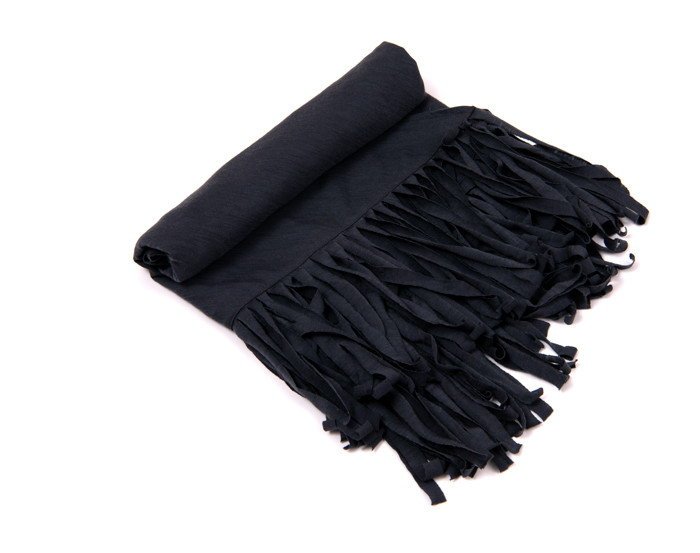
A fringed wrap laid flat. The twist direction, fringe length and the density of strands per centimetre are all measurable from a reference sample like this.
6. The Pashmina Truth Table: What "100%" Actually Buys
This is the conversation that decides whether your collection reads as heritage or as accessible luxury — and both are legitimate positions, provided you know which one you are buying.
Route
Fibre and processing
Typical hand
Supply reality
Pure pashmina
Himalayan down fibre, hand-spun and hand-woven
The softest, lightest and most open hand available; semi-sheer in fine weaves
Long production lead times and higher minimums; the piece is an heirloom claim
Premium Inner Mongolia cashmere
Selected undercoat fibre spun and woven by machine, hand-finished where needed
Very soft with slightly more body; consistent piece to piece
Shorter lead times, lower minimums, scalable reorders — the workhorse
Cashmere-silk blend
Cashmere with mulberry silk in the yarn
Added sheen and drape; holds a pressed fold better
The route for embroidered and printed pieces, and for lighter transitional weights
Cashmere-wool blend
Cashmere blended with fine wool
Heavier, more structured drape, more outerwear-like
Growing demand in colder markets where the wrap is worn as outerwear
Brands with a Himalayan heritage story should buy the first route and accept the longer lead times and higher minimums that come with it. Brands building accessible luxury or a fast-restock programme should buy the second, specify the micron band, and put the certification on the label. Industry analysis of current pashmina demand makes the same point from the manufacturing side: the material choice is a positioning decision, and blending down to hit a target look is what erodes a category's credibility. You can also compare how the same fibre story reads across the wider pashmina scarf segment.
The verification habit that protects you is simple. Ask for the fibre-origin document and the micron result together. A supplier who can only produce one of the two is telling you something useful.
7. Colour, Weight and the Travel-Layer Buy Calendar
Colour decisions in this category are less about novelty than about range architecture. Current demand clusters around warm neutrals — camel, oatmeal, ivory, taupe, deep navy and charcoal — with a small number of seasonal accents carried for display rather than for volume. The discipline that keeps a wrap programme coherent is to build the core in one yarn lot so that every colour in the range matches in hand, then add the accents from the same lot. Our cashmere accessories range and the 2026 collection show how that palette is currently merchandised, including the home and throw extension of the same neutrals.
Weight selection follows the same logic as colour, and it is the number most often left off the brief.
Weight band
Piece weight guide
Where it sells
Light / transitional
Roughly 150–250 g
Warm-climate accounts, in-flight and hotel retail, spring gifting
Mid / core
Roughly 300–500 g
The volume band for department stores and boutiques in temperate markets
Heavy / outerwear substitute
Roughly 600 g and above
Colder markets, where the wrap is worn instead of a coat
On timing, the sequence that keeps stock on shelf for the travel season runs in four stages. Fibre and colour approval come first, using the yarn card rather than a photograph. Sampling second, with the accepted sample signed and retained as the golden reference. Bulk knitting and dyeing third, in a single lot wherever possible so the colour is uniform across the order. Finishing, pressing and packing last — this stage is where fringe twisting and trim attachment happen, and it should be inspected against the retained sample rather than against a new photo.
Work backwards from your own in-store date and one fact becomes obvious: the wrap that needs to be on a shelf or a hotel display for the winter travel window is decided on fibre and colour months earlier. Build the programme from the delivery date, and the season takes care of itself.
8. Wholesale Cashmere Wrap and Poncho FAQ
Is pashmina simply another word for cashmere?
Not technically. Pashmina refers to down fibre from high-altitude Himalayan goats, traditionally hand-spun and hand-woven, and typically measuring around 12–16 microns. Standard machine-spun cashmere generally sits at 15–19 microns. In commercial use the words are often used loosely, which is why the fibre content and origin should be documented on the specification sheet and stated correctly on the label.
What is the difference between a wrap, a stole and a shawl?
It is mostly a question of width and use. A stole is a flat, dressier rectangle. A shawl or wrap is wider, generally 80 × 200 cm and above, so it can cover the shoulders and function as a layer rather than as neckwear. In practice the terms overlap heavily, so the reliable approach is to specify finished dimensions rather than rely on the name.
How do I check that a poncho is genuinely seamless?
Turn it inside out and run a hand along the shoulder line and the neck opening. A seamless piece has no linked seam there, so the drape is continuous and the neck edge reads as a knitted loop rather than as a joining line. You can also ask for the construction to be named on the specification sheet, then verify it on the golden sample.
Which certifications should I ask for on a cashmere wrap?
Two are the usual requests: a fibre-sourcing or traceability certification such as The Good Cashmere Standard, and finished-textile chemical safety under OEKO-TEX Standard 100. Both are held by specific facilities rather than by trading intermediaries, so confirm which production site is covered and whether your order will actually be made there.
How do I stop quality drifting between the first order and the reorder?
Four controls do most of the work: a retained golden sample, finished piece weight with a stated tolerance, a measured micron value rather than a description, and a fringe density specification. Add a yarn-card or Pantone reference with a batch-match tolerance for colour. Together these turn "it feels different" into a number either side can check.